The BMW i7 takes in-car entertainment to the next level

Remember simpler times when a thing was just, well, a thing and nothing else? Like when your phone was just a phone, for example, and not an ‘unkillable’ connection to late-night work emails and photos of your friends’ kids or pets? Or when your watch just told the time and didn’t count steps (too few), calories (too many) and sleep cycles (or lack thereof)?

Those times have changed, of course, and nowhere is that more obvious than from inside the new BMW i7 – the German powerhouse’s new electric flagship vehicle. Because while it’s obviously a car, that’s really the least of its abilities.

But let us start from the top. The 7 Series has been BMW’s flagship model since 1977. It’s one of those limousine-style cars in that you’re every bit as likely to find the owner nestled in the rear seat as you are behind the wheel, and where the brand has traditionally debuted its newest and most cutting-edge tech.

Usually, such stuff falls into the boring-but-important camp – things like smarter headlights or new navigation – most of which would eventually filter down to BMW’s lesser models. But something tells me that won’t be the case this time around. Because fitting what feels like a cinema-sized screen into the back of a bite-sized 1-Series could prove too big a challenge.

But there are no such space issues in the backseat of the i7, an area so large  –and so trimmed with real wood grain and animal pelts – you feel like it should be measured by the acre. And this is why the brand has been able to change the in-car entertainment game so comprehensively.

Luxury BMW i7 appeal

You know those iPad holders you can buy for the back of the front-seat headrests to keep the kids entertained on longer trips? Well, BMW has got its own version, except the German solution is a little more impressive.
You slide into the back seat – which, by the way, is wrapped in cashmere and offers a full-body massage function – and then, at the push of a digital button, the cabin transforms from vehicle to all-out rolling cinema.

First, automatic blinds deploy over all the rear glass windows, blocking movie-ruining light from the backseat. Next, a massive 79.5 centimeter screen unfolds from the middle of the roof of the i7, obstructing the view out of the front windscreen (and with it, the remaining light) and converting the BMW into less of a drive-in cinema and more of a high-tech drive-thru cinema.

It runs Amazon Fire, which delivers the major streaming services straight to your back seat, and pairs with a 35-speaker Bowers & Wilkins surround-sound system that includes seat shakers for a body-shaking 4D experience.

It’s seriously jaw-dropping tech, and it makes all the other cool stuff pale in comparison.

Take, for example, the Swarovski crystal front lights, which dance a happy digital dance every time you unlock the car, or the fact that, should you return to your i7 and find someone has parked too close, you can simply move your car out of the spot using a self-driving app on your smartphone.

The screen can Zoom, too, for those unavoidable meetings, however, what BMW calls the “Theatre Screen” is far more impressive when you’re playing a Hollywood blockbuster at full noise.

Effortless driving
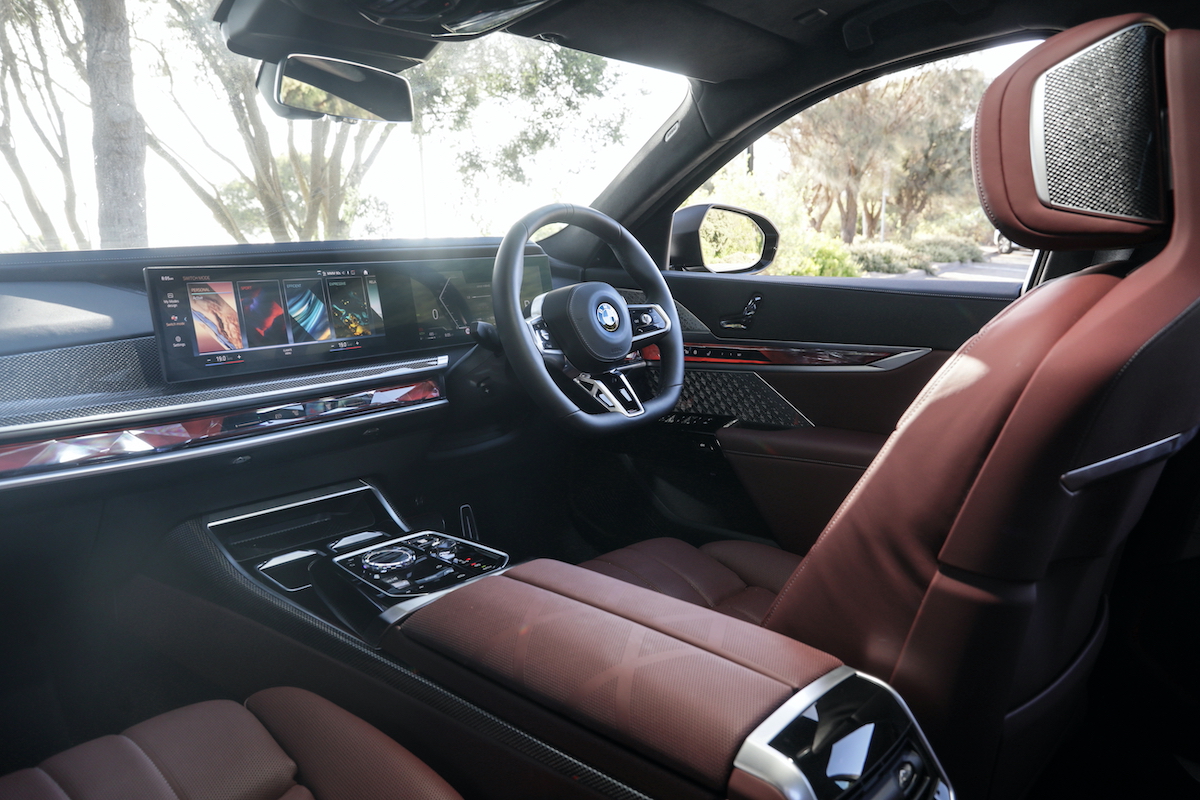
Electricity is well on its way to taking over every possible new-car segment, but I don’t think any vehicle type suits the silent, torque-rich nature of an EV as much as a high-end limousine.

In the i7, two small-but-powerful electric motors, one positioned at each axle, replace what would have been six, eight or even 12 cylinders. Combined, there’s 400 kilowatts in power and 745 newton meters in torque on offer, which is more power and about the same torque as the previous generation’s V8 engine produced.

It’s enough to push this 2.6 metric ton luxo-barge to 100 kilometers per hour in a spritely 4.7 seconds.

But to plant your foot and hold on is to miss the point here. Instead, use the power only as you need it, and you’ll flow through traffic in near-silent and entirely effortless fashion.

The i7 is not attempting to be a performance EV – it leaves that to models like the Porsche Taycan. Instead, its one true mission is to protect the cabin’s occupants from whatever is happening outside its windows, as well as whatever is happening beneath its tires.

With the adaptive air suspension set to its most comfortable settings, the i7 genuinely glides over rough road surfaces. There is no big engine noise to dull, and so the cabin is remarkably quiet, keeping the outside world from interrupting your ambience as surely as if you were behind a space shuttle airlock.

The ‘sound signature’
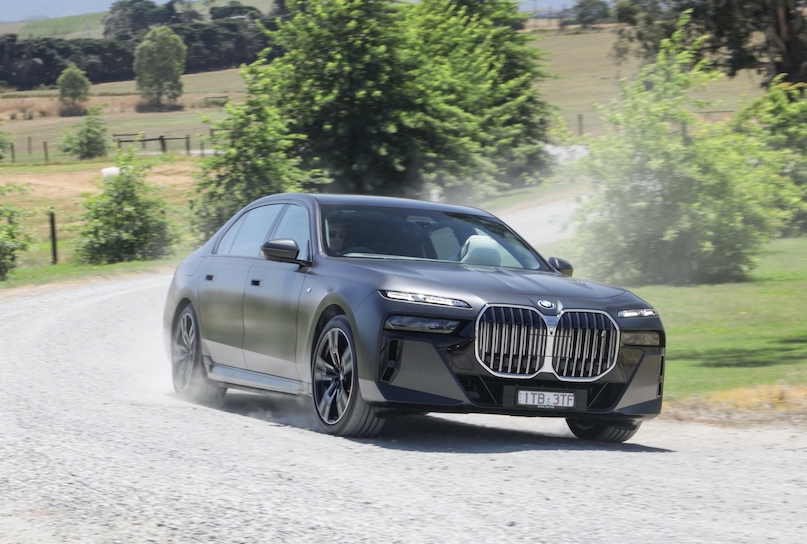
When you do want noise, you can call on famed composer Hans Zimmer, with each driving mode adopting its own sound signature – with some sounding like an orchestra sweetly swelling with your acceleration, and others that sound, at low speeds, at least, like someone is stamping on a half-inflated bagpipe. Either way, it’s the most unique example of an EV soundtrack that we’ve encountered.

Delivering range is a big 106 kilowatts-per-hour lithium-ion battery, which BMW says will return an “up to 625 kilometers” driving range on the worldwide harmonized light vehicle cycle. When it does come time to plug it in, the i7 can accept 195 kilowatt direct-current fast charging, which should see you go from 10 percent to 80 percent charged in around 34 minutes and accrue 170 kilometers in driving range every 10 minutes.

Plugging it in at home will take a lot longer.

This is a big battery and even with a seven kilowatt wallbox, you’re looking at around 16 hours to charge the battery.  A standard plug will take a touch over 50 hours to get the same charge.

The i7 is yours for US$206,020, which is a sizable investment. But I would argue that you won’t find this level of technology, effortless forward progress or luxury outside of a Rolls-Royce or Bentley. And when you look at it that way, the BMW i7 suddenly starts to feel like a very expensive bargain.

The Porsche Cayman GT4 RS is full of (good) surprises

What is it about we human beings that makes us enjoy the painful failures of others? Do warthogs quietly thrill when one of their kind trips, wallows and is eaten by a predator? Would any other species in the universe enjoy ‘fail’ videos as we do?

This question might be beyond me, but I must admit to occasionally wanting car companies – even my favorite ones – to falter. I can’t really explain why I’d like Porsche to stuff up and build something a bit ordinary, even once – inherent cruelty, a need to believe that no-one and nothing can succeed forever, perhaps – but I do.

Or I did, until Porsche introduced the 718 Cayman, a vehicle that abandoned its legendarily lush and lovely six-cylinder boxer engines in favor of new, more economical, perhaps even more sensible four-cylinder ones.

Typically, this Cayman – blessed with mid-engined balance and superlative steering like its forebears – was still undeniably fantastic to drive, but the unusual and borderline unbelievable failing was that its new engines sounded like large, farting dogs being whistled for by their owners. Or like a Subaru WRX, if you wanted to be kind.

porsche cayman

The 718 version of the Cayman was launched back in 2016 and, while it sold well enough, really it became showroom bait, with a price tempting enough to get a dreamer into a Porsche dealer, where they would soon realize that if they paid just a bit more they could have the 911 they’d always dreamed of, with a proper engine in it.

It’s taken Porsche a while, but it has now, finally, produced a 718 Cayman that makes up for all that, a vehicle so brilliant that it makes you forget, and forgive, all that came before it.

The solution was staggeringly simple – just rip the bonkers 4.0-liter six-cylinder naturally aspirated engine from the far larger and more expensive 911 GT3 and somehow shove it into the Cayman’s smaller and more sporting chassis (while the engine of a 911 hangs out over its tail, where physics would suggest it doesn’t belong, a Cayman places its powerplant in the middle, providing perfect balance).

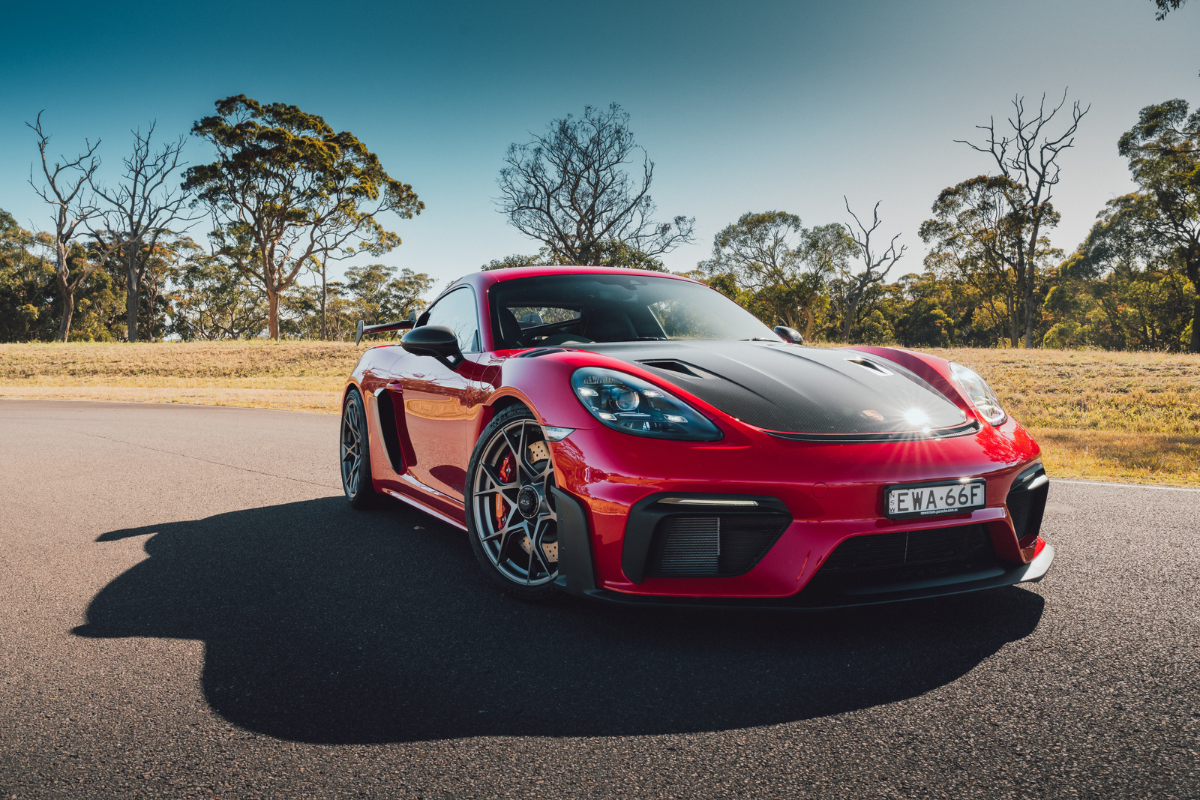
The result is something akin to shoving a whopping old HSV V8 into a Mazda MX-5, only a lot better thought out. The Cayman GT4 RS is a 368 kilowatt monster, just like the 911 GT3, but it’s doing its work in a smaller, lighter and sharper Cayman.

Interior inspection


cayman interior

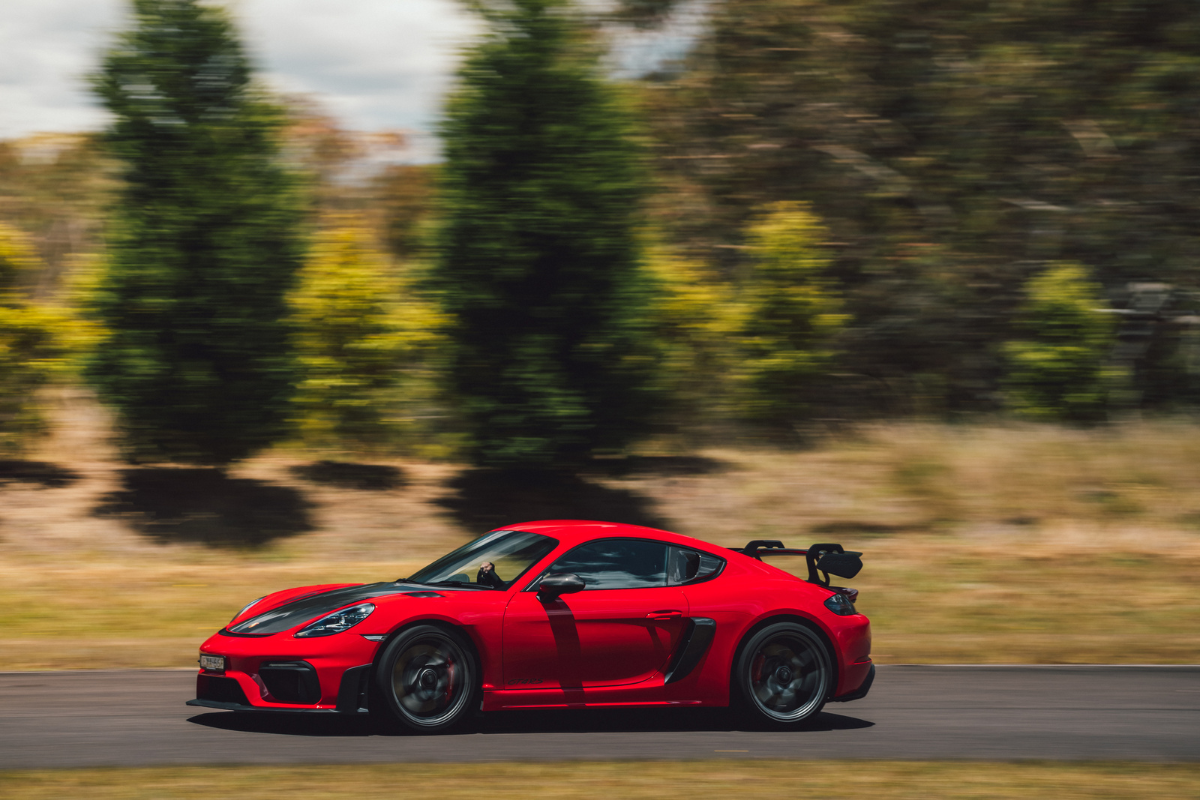
The result is superlative, although its styling – which looks like someone sprayed a fire hose filled with carbon fiber at a red car – might not be to everyone’s taste.


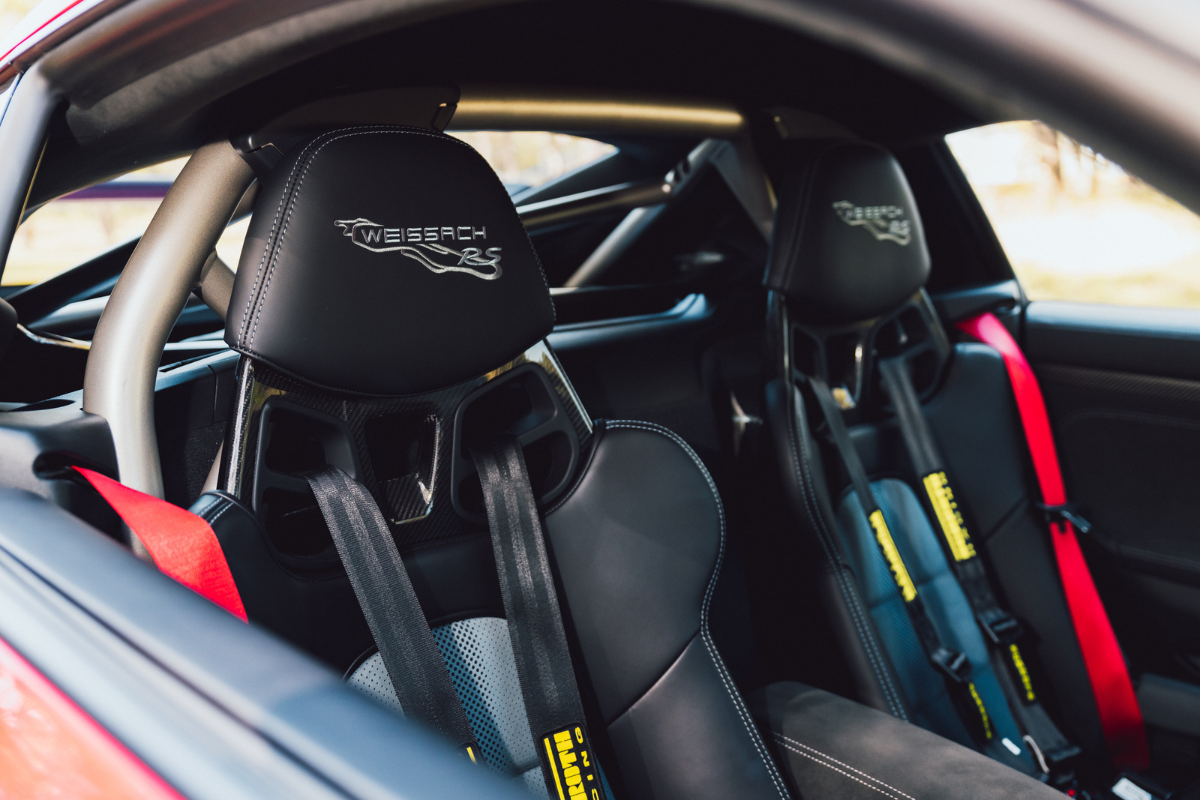
From the driver’s seat – a brutally hard and difficult to enter racing bucket, complete with four-point harnesses – it looks fabulous, however. There’s a little lip of carbon that smiles at you through the windscreen, a fire extinguisher in the passenger footwell to remind you that this Cayman was built more for racing than the road, and maps of Porsche’s Weissach test circuit sewn into the head rests (which shouts “take me seriously” more stridently than getting big tattoos of dragons and breasts).

What you also immediately notice about the interior is that it’s now almost seven years old, with a dated screen and infotainment setup that lacks many of the mod cons you’d get on an SUV Porsche these days. You might think this matters not, but on a vehicle that costs over US$149,000 it’s something of a shock, and a sure sign that this will be the last version of the 718 Cayman before an all-new version arrives.

The one bit of old-school tech I wish they had included is a manual gearbox, but RS cars are all PDK (savagely fast, flappy paddle gearboxes), and in this case the amount of torque the big engine is making (450 nanometers) would be just too much for any clutch.

As soon as you start driving the Cayman GT4 RS, your ears start to hurt.

While many cars would offer some kind of wall, or screen, or even some flimsy plastic between your head and the engine, this Porsche’s mad six sits in the car with you, a precious few inches from your head.

This is disconcerting, and then delightful, as you discover that the throttle becomes a musical instrument of sorts, or perhaps the conductor of an orchestra made up of orcs belting each other with metal hammers (and there’s even a little button you can press to make it louder still).

An overwhelming drive


cayman porsche

Spin the RS up to its redline at 9,000 revolutions per minute and your spine tingles like a tuning fork. It’s utterly brilliant. It’s also stupidly fast, of course, with a 0–100 kilometers per hour time of  3.4 seconds, which doesn’t tell you quite as much as this car’s ridiculous time around the legendary Nurburgring, a lap of seven minutes and 9.3 seconds, which is a whopping 23.6 seconds faster than the Cayman GT4 this car is based on.


What should properly boggle your mind is that this lap time is also even faster than a McLaren 720S, one of the most terrifyingly fast supercars a lot of money can buy.

All of that speed and grunt is particularly enjoyable to put to the ground because this Cayman is so powerfully planted to the road, in no small part by its vast rear wing.

The steering is also track-car terrific, the brakes quite astonishing and the whole package, in sum, almost overwhelming.

The trade-off, of course, is that the suspension, designed for marble smooth race tracks rather than the real world, can cause your spine to stop singing like a tuning fork and start shrieking for mercy. You really do start scanning the road ahead for bumps and doing anything you can to dart around them.

When Porsche lent me this car they actually asked whether I’d be taking it to a track, clearly assuming that I own one, and I can see that this would be the most sensible, and sensational, thing to do with this car. But even on public roads, particularly the good, smooth bits, the Cayman GT4 RS grabs you by the shirtfront and insists that you drive it hard, and give yourself a good fright or two.

It may well be the last Cayman 718 we’ll ever see, but what’s not in doubt is that it’s also the greatest of its line. Frankly, it’s almost annoyingly good.

Automaker Aston Martin brings its luxury design mastery to Tokyo

The address No. 001 Minami Aoyama is situated in an upscale Tokyo neighborhood dotted with eclectic galleries, cafes and boutiques housed in extraordinarily creative buildings.

An art museum – with a beautiful Japanese garden on its grounds – sits behind a wall of bamboo. Within walking distance, the buzzy streets of quirky Harajuku and Omotesando’s sweeping designer thoroughfares are packed with people – clear evidence the megacity’s come back to life with a vengeance.

Tucked into a side street in what press materials call “one of Tokyo’s foremost architectural and style centers”, Aston Martin’s latest residential project marks the luxury performance brand’s first in Asia.

“Minami Aoyama is incredibly peaceful for an area that’s right smack bang in the middle of the largest, most hyperactive city on the planet,” says Director of Partnerships Cathal Loughnane.

“Tokyo’s neighborhoods kind of flow from one thing to the next, one type of district to another. That’s why it’s amazing. You can go from a full luxury shopping district into the quietest residential street in 100 meters, which you just don’t get anywhere in the world.”

The property was conceived in-house by the acclaimed Aston Martin Design team – the entity that drafts the brand’s other residential ventures, as well as all of their dealerships. In collaboration with Vibroa, a leader in Japanese real estate, and a local, on-the-ground construction company, it will become a reality.

Aston Martin Executive Vice President and Chief Creative Officer Marek Reichman calls the project a “unification of two ultra-luxury lifestyle organizations with a shared passion for combining cutting-edge design and technology with traditional hand craftsmanship.”

TEXT

Masterful luxury design

The striking four-story home is all clean lines, wood and glass, elements of geometry. The British automaker’s design principles – with a uniquely Japanese influence – are reflected throughout.

An ultra-modern facade delivers privacy yet demands a second look. Huge windows create seamless transitions to the outside world.

It’s a rarity in a city where space is at such a premium. Tokyo’s zoning laws – more relaxed than those in other cities – mean shiny new buildings often crowd up against charming storefronts from another time.

Business towers, izakaya (informal bars), tiny homes and ubiquitous convenience stores are wedged, stacked and mashed together. An empty bit of land, however awkwardly shaped, is an invitation to build.

“Normally, on a plot this size in Tokyo, you’d be building multi-family homes. The neighbors don’t believe it’s going to be one home. They’re expecting it to be four or five apartments,” Loughnane says.

“For Tokyo, it’s extraordinarily luxurious.”

Inside, dark wood, lots of natural light and a spacious floor plan create the feel of a minimalist sanctuary. Amenities include a wine cellar, home cinema, gym, private spa and an outdoor onsen-like tub.

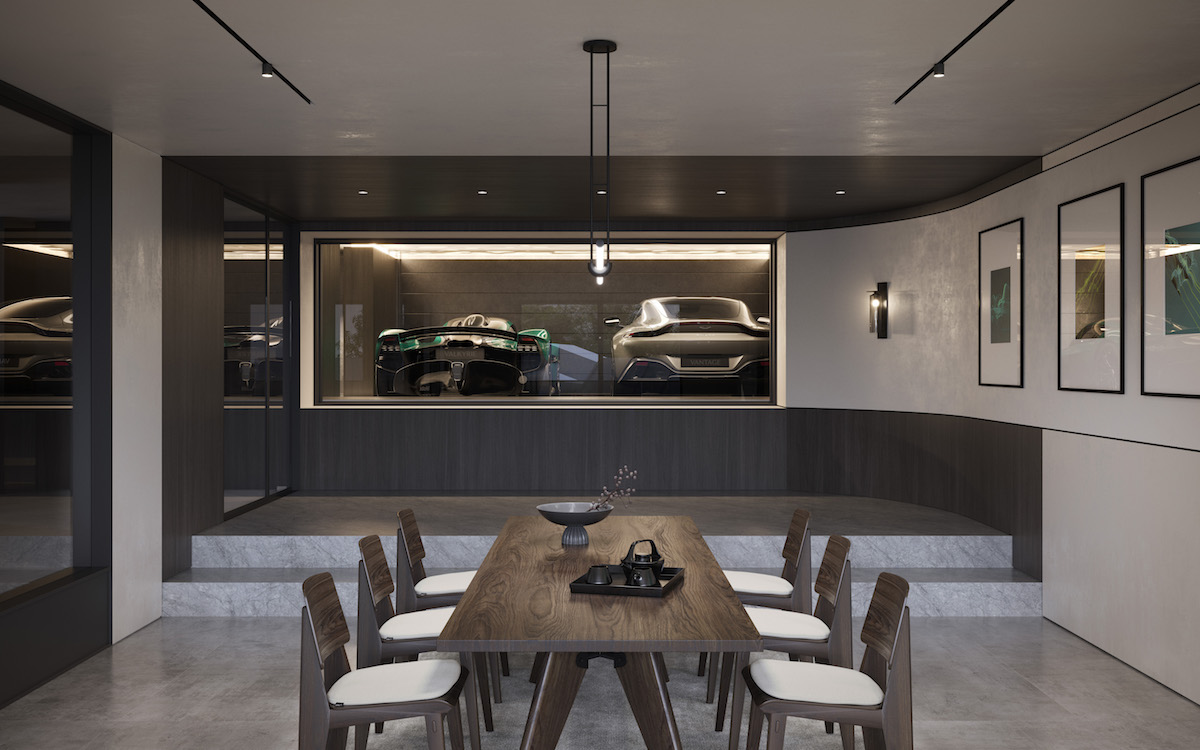
A rooftop garden overlooks the surrounding city. And of course, an automotive garage-cum-gallery displays the new owner’s car collection, which can be viewed from the dining room through a glass wall.

Later this year, after about five years of preparation and one year of designing, construction is expected to wrap and a private buyer will move in.

“This is our first project where we knew the owner from the beginning. They’ve been very much involved,” Loughnane says.

The project’s now coming down to the final details and custom elements – the carpeting and light finishes, the ideal shade of the wood and the perfect finish on the stone.

TEXT

High-tech precision meets handcrafted elegance

“Every country has their own unique vision of the car. But Japan is one of the real standouts,” Loughnane says.

“The car culture in Tokyo is incredible – from the drift culture and the tuning culture to the crazy stuff like the Bosozoku and extreme cars.”

Some of Aston Martin’s most enthusiastic collectors are in Japan. One of the first Valkyrie AMR Pros was delivered there. One of just 25 existing DB-5 Continuation cars (complete with all the James Bond gadgets) is in Tokyo as well.

Aston Martin’s work in Japan is a natural culmination of appreciation for impeccable design, both old and new.

The distinct influence of the country, its style, culture and history, holds an important creative space within the automaker’s design studio. And through cars, architecture or something else entirely, fine craftsmanship has been revered in Japan for centuries.

“Japan has an extraordinarily strong design culture,” Loughnane says, referencing the gleaming machines in the automotive gallery, balanced by features crafted through a millennia-old process that’s been handed down through generations.

“There’s this incredible contrast in a culture that’s extremely forward-thinking, extremely innovative, but also has incredible respect for the ancient traditions and is investing an awful lot of energy into making sure that the technologies of the future don’t erase the traditions of the past.”

Following successful residential projects in the United States in Miami, Florida and Rhinebeck, New York, there are ongoing discussions for future projects Stateside, in the United Kingdom and in Europe. Further sites are being scouted for potential homes in Japan.

“We’re fortunate,” Loughnane says. “We have far more opportunities than we have architects at the moment, which is a good place to be.”

The Ineos Grenadier is an outstanding outlier among off-roaders

Paused precariously on a thin spit of land on a remote Scottish Highlands estate is a convoy of mud-plastered 4x4s. I’m nearing the end of an arduous day’s off-roading, woozy with fatigue.

Twilight is looming. Drizzle flicks the windscreen. And it’s freezing. It’s always freezing here, even in summer probably. Do the Scots even have a word for summer?

Now the Ineos driving guide is ordering us via walkie-talkie to ford a loch. There is no visible path ahead, just murky water, possibly filled with monsters. The only choice I have is to blindly follow the vehicle in front, and hope.

Hope said vehicle is on the correct trajectory (and the driver isn’t an imbecile). Hope I’ve got a few drops of awakeness left in the tank. Hope I don’t veer too far left or right. Hope I don’t meet a cold, wet death for the sake of a car review.

If you’re wondering what you’re looking at, yes, the boxy Ineos Grenadier does bear more than a passing resemblance to the original and much beloved Land Rover Defender. But that’s kind of the point.

In 2016 the Defender was, controversially, subject to a radical overhaul by the folks at Land Rover, resulting in a new, surprisingly modern car that inhabited a different spacetime dimension to its iconic forebear.

Step up Jim Ratcliffe, CEO of petrochemical multinational Ineos, and one of Britain’s richest people with an estimated net worth of US$15.3 billion. He’s also a Defender purist.

Innovative Beginnings


ineos grenadier

According to what is now motoring folklore, while having a pint in his local London pub – The Grenadier – Ratcliffe identified a potential gap in the market for a robust off-road workhorse, one built to modern specs with best-in-class engineering.


So what if his company had no automotive history, bar owning a stake in the Mercedes F1 team? So what if it would cost more than a billion euros to realize his vision? He was good for it. And may have had a few pints.

Cue six years of R&D, during which Ineos bought a state-of-the-art production factory in Germany, faced down a lawsuit from Jaguar Land Rover over the visual similarities to the old Defender and, just for giggles, bought the pub where the idea was born.

So here we are in early 2023, emerging from an icy loch in one piece, lungs not full of water, strangely calm. That’s the overriding sensation when you drive the new Grenadier: no matter the landscape, it’s utterly fearless and unstoppable.

During an epic two-day escapade, I traversed lochs filled with large, sharp sheets of floating ice, descended vertiginous tracks at impossible angles, and climbed the kind of rock-studded hills that would make even mountain goats hesitate – and still the Grenadier didn’t blink.

At the heart of the car’s supreme toughness is its super-stiff full box section, ladder-frame chassis. Additional beef is provided by heavy-duty solid-beam axles, developed in conjunction with agricultural machinery firm, Carraro.

Impressive pieces of architecture, sure, which go some way to providing a 3.5-metric ton towing capacity and 5.5 metric tons of winching power, but the Grenadier isn’t an industrial earthmover.

Brawn and comfort are needed if Ineos wants to break into a market already dominated, at the rough-and-tumble end, by the Toyota LandCruiser 70, and on the lifestyle side, by the Mercedes G-Wagen and Jeep Wrangler.

Smooth Riding


ineos

To this end, the Grenadier is equipped with progressive coil spring suspension and anti-roll bars, so that even on the most boisterous tracks, the ride is nowhere near as bumpy as it should be.


Even when tilted at insane gradients, you never think the car is in danger of flipping, especially with Downhill Assist mode engaged. In this setting you don’t even have to use the brake. Simply press the button, sit back and let the Grenadier handle the forward momentum all by itself.

As is to be expected in a four-wheel drive of this kind, there’s a separate, manually operated low-range transfer case that sends torque and power to the front and rear axles, with a lockable center-differential.

Additional front and rear diff locks can be optioned but, honestly, you’d only need to use them in the most extreme circumstances, like driving to the summit of Mount Everest.

With first orders about to land in Australia, where the car will now cost US$66,800 plus on-roads (up from the original price of US$58,200), the good news for early adopters is the Grenadier isn’t just a stylish tractor.

BMW’s six-cylinder, 3.0-liter engine, available in diesel or petrol, delivers huge amounts of torque (550 Newton-meters/450 Newton-meters respectively) off-road but, in combination with the German company’s eight-speed transmission, the car is surprisingly refined on conventional roads, too, and the switch from mud to tarmac in Scotland was seamless.

The only minor criticism is that the slightly vague steering requires frequent minor adjustments, which feels more noticeable on a sealed road.

With its rugged good looks and classic heritage shape, it’s easy to see the Grenadier appealing to buyers who are more likely to park the car at the soccer field than drive on an actual field.

But serious 4×4 enthusiasts and adventurers are catered for, with a long list of functional features, including 2,000 liters of load space, 30:70 split rear doors to make loading easier, beltlines along the body, rear ladder and optional roof rack or cross bars for carrying extra kit.

Inclined to get a bit mucky after a day’s trail biking? Rest easy. The whole interior can be safely hosed down (just like a Defender).

Hi-Tech Interior


off-road

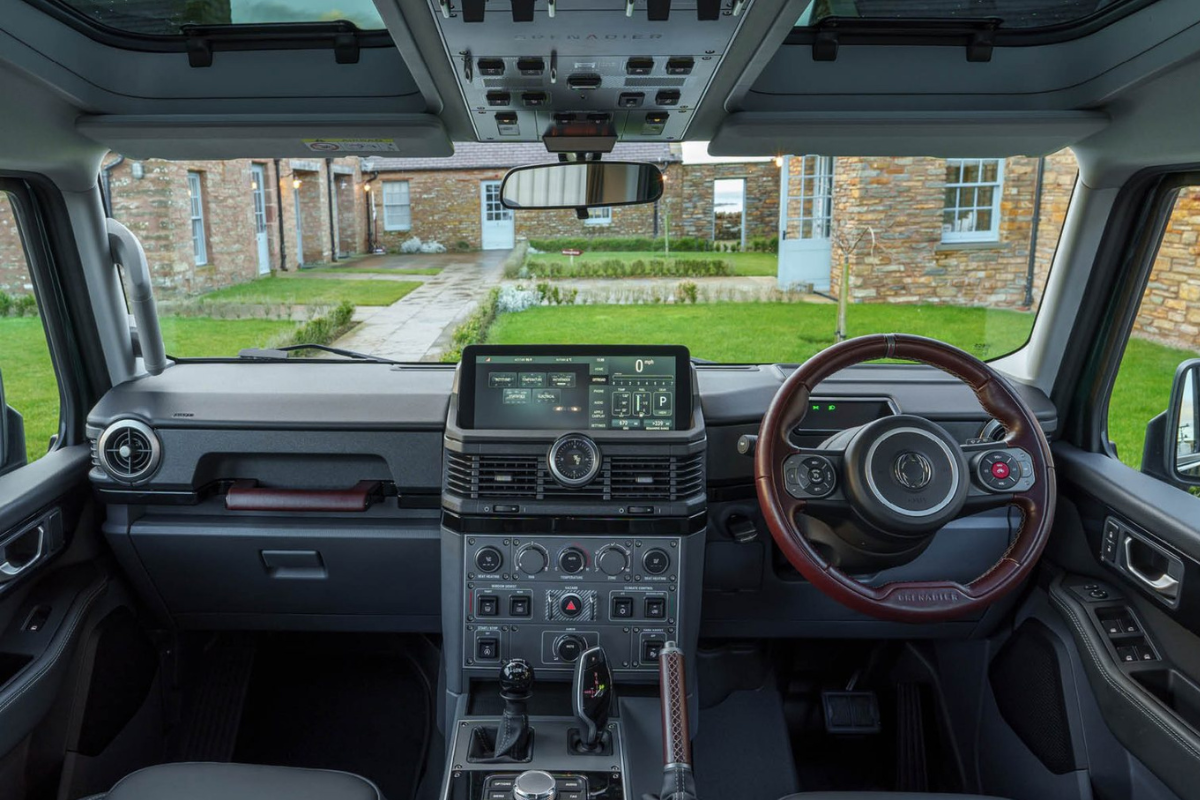
In fact, it’s inside where Ineos has done some of its best work. Adorned with a chunky analogue switchgear and hard-wearing cloth and vinyl, the cabin feels appealingly spare and old-school, and totally original to this model, especially the aviation-inspired overheard control panel, bringing a sense of drama to the experience.


And yet in other respects the Grenadier is bang up-to-date; there’s a large 31.2-centimeter central touchscreen, which – as well as the predictable stuff – displays cool things like steering angle, vehicle attitude and your current coordinates. Android Auto and Apple CarPlay are standard. The audio system rocks.

From inside to out, it feels like a tremendous amount of thought has gone into this car.

Car? It feels wrong to call it a car. Most production vehicles are fairly one dimensional; they go from A to B, they move fast-ish, they (sometimes) make you look cool. The Grenadier is something else: a machine, a tour de force, an outlier.

And, if you happen to be driving blindly across a cold Highlands loch, perhaps a potential lifesaver.